Is Behentrimonium Methosulfate a Sulfate? What BTMS Does in Our Conditioner Bars
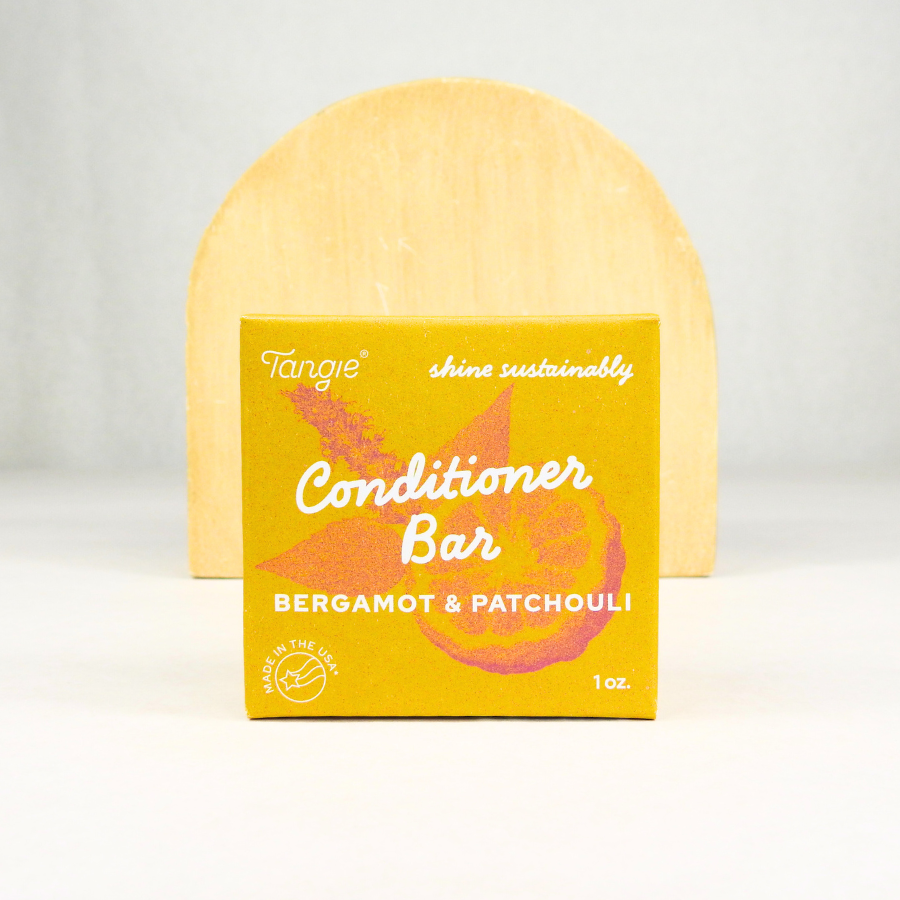
The quick answer for this question is: No, Behentrimonium methosulfate (BTMS) is not a sulfate cleanser. It’s a positively charged (cationic) conditioning agent made from rapeseed oil. It clings to hair, smooths the surface, and cuts static, so hair combs out with less pulling. The “methosulfate” in the name is a small partner ion that balances the charge. It doesn’t foam or strip oil the way sodium lauryl sulfate (SLS) does.
BTMS is in every Tangie conditioner bar. If you saw “sulfate” on our ingredient list and paused, that’s a fair reaction. You should know what you’re putting on your head.
TL;DR
| BTMS isn’t a sulfate. Sulfate cleansers carry a negative charge and wash oil away. BTMS carries a positive charge and stays on hair to condition it. |
| It works like a magnet. Hair has a negative surface charge. BTMS is drawn to it, coats the cuticle and lowers friction and static. |
| It’s plant-derived. BTMS comes from rapeseed (canola) oil. It’s vegan. |
| Safety reviewers cleared it. The Cosmetic Ingredient Review Expert Panel found it safe as used in cosmetics, when products are formulated so they don’t irritate. |
| We use it for a reason. It gives a solid bar slip and detangling power without silicones or a plastic bottle. |
Table of contents
- Behentrimonium Methosulfate Explained
- Why “Methosulfate” Doesn’t Make it a Sulfate
- How BTMS Works On Hair?
- Why do Tangieco products have behentrimonium methosulfate?
- Behentrimonium methosulfate toxicity: what the safety research says
- The environmental question
- How to use a BTMS conditioner bar
- Quick answers
- Sources
Behentrimonium Methosulfate Explained
Behentrimonium methosulfate is a quaternary ammonium salt used as a conditioning agent and emulsifier in hair and skin care. Its long, 22-carbon tail comes from rapeseed oil.
The short name is BTMS. On a label, it may also appear as behenyl trimethyl ammonium methosulfate or docosyltrimethylammonium methyl sulfate. Same ingredient.
How it works
- Binds to hair. Its positive charge pulls it toward the negatively charged surface of each strand.
- Smooths and detangles. It leaves a thin film that lowers friction, so wet hair slides apart instead of knotting.
- Calms static. The positive charge cancels out the negative charge that makes dry hair fly away.
- Blends oil and water. It acts as an emulsifier, which gives creams and conditioners a smooth texture.
- Holds its shape. It’s a waxy solid at room temperature, which helps a conditioner bar stay firm.
Benefits of behentrimonium methosulfate for hair and skin
- Hair: softer feel, easier wet combing and less frizz from static. That’s why it shows up in rinse-out conditioners, leave-ins, hair masks and solid conditioner bars.
- Skin: in lotions and creams, it helps the formula hold together and leaves what suppliers describe as a soft, powdery feel. Our products use it for hair, not skin.
Why “Methosulfate” Doesn’t Make it a Sulfate
The word “sulfate” in a cleanser refers to the part that does the cleaning. In BTMS, the methosulfate part does no cleaning at all. It’s there to balance the electrical charge.
When people say “sulfates” in hair care, they mean SLS and sodium laureth sulfate (SLES). These are anionic surfactants. Their cleaning end has a negative charge, and their job is to grab oil and dirt and rinse it away. That’s what makes them foam, and it’s why some people find them drying.
BTMS is built the other way around. The working end is a positively charged nitrogen with a long fatty tail attached. A positive ion can’t sit alone, so it’s paired with a negative one. In BTMS, that partner is methyl sulfate (methosulfate). It works like the counterweight on a scale: it keeps the salt stable, then stays out of the way.
| Sodium lauryl sulfate (SLS) | Behentrimonium methosulfate (BTMS) | |
|---|---|---|
| Charge of the working part | Negative (anionic) | Positive (cationic) |
| Job | Cleans and foams | Conditions and detangles |
| Effect on hair oils | Removes them | Leaves a light film |
| Where you find it | Shampoo, body wash, toothpaste | Conditioner, leave-in, lotion |
| Role of the “sulfate” part | Part of the cleaning molecule | Counter-ion that balances charge |
So a conditioner can contain BTMS and still be free of sulfate cleansers. Those are two different ingredient families.
How BTMS Works On Hair?
Hair carries a negative surface charge at the pH of shampoo and conditioner. BTMS carries a positive one. Opposite charges attract, so BTMS sticks where hair needs it most.
Hair is made of keratin, a protein. A paper in the Journal of Cosmetic Science puts the isoelectric point of unaltered human hair near pH 3.67, and lower still in bleached hair. Above that pH, hair carries a net negative charge. Nearly every hair product sits above pH 3.67. Our conditioner bars, for example, usually measure between pH 5 and 7.
That negative charge causes two everyday problems:
- Static. Strands with the same charge push away from each other. You see it as flyaways in dry winter air.
- Friction. The cuticle edges catch on each other. A 2014 review in the International Journal of Trichology links higher negative charge to more friction between fibers, which can lead to cuticle damage and frizz.
BTMS handles both at the surface. Its positive head lands on the negative spots along the strand, and its long fatty tail lies flat over the cuticle. Combs and fingers glide over that film instead of snagging.
Bleached hair carries even more negative charge, so it tends to pull in more conditioner.
BTMS has a 22-carbon tail, one of the longer chains used in hair care. Shorter-chain conditioners such as cetrimonium chloride have 16 carbons. Supplier data sheets credit that long C22 tail for BTMS’s wet-combing and detangling performance. We compare BTMS with its close relative in BTMS vs Behentrimonium Chloride: What’s the Difference?

Why do Tangieco products have behentrimonium methosulfate?
A conditioner bar has no water and no bottle. It needs a conditioning agent that’s solid, plant-derived and strong enough to detangle without silicones. BTMS checks all three.
It works in a solid bar
Liquid conditioners are mostly water. A bar isn’t. Every ingredient has to stay firm on a shower shelf and soften on wet hair. The BTMS blends formulators buy melt at roughly 55 to 65°C (131 to 149°F). They stay solid at room temperature and soften when they meet warm water and friction.
It’s plant-derived and vegan
The BTMS we use comes from rapeseed (Brassica napus). That matters to us. All our bars are vegan and Leaping Bunny certified.
“Plant-derived” isn’t the same as “straight from the plant,” though. The fatty acid from rapeseed oil goes through several processing steps in a lab before it becomes BTMS. We’d rather say that plainly than call it “natural” and leave it there.
It replaces silicones
Many bottled conditioners use silicones such as dimethicone for slip. Our conditioner bars are silicone-free, and BTMS supplies the slip and detangling instead.
Where you’ll find it in our line
Our conditioner bars all start from the same base:
- Emulsifier blend: cetearyl alcohol and behentrimonium methosulfate
- Cocoa butter
- Cetyl alcohol
- Coconut oil and glycerin (USP)
- Extra virgin olive oil, wheat germ oil and jojoba oil
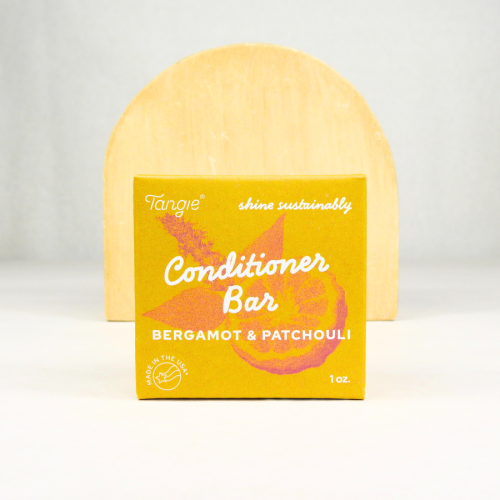
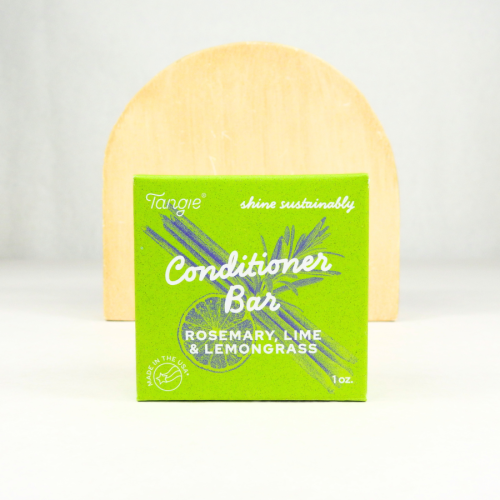
BTMS appears in all seven Tangie conditioner bars, plus the Fixtone Purple Conditioner and the Superfoods Conditioner. You can check every ingredient we use in our ingredients library.
The fatty alcohols on that list (cetearyl and cetyl) aren’t drying alcohols. They work as a team with BTMS. See Is Cetearyl Alcohol Bad for Hair? Fatty Alcohols Explained for why. Cocoa butter adds softness, covered in Cocoa Butter in Conditioner Bars: What It Does for Hair.
For the full lineup, read What’s Actually in a Conditioner Bar? Ingredient by Ingredient.
Behentrimonium methosulfate toxicity: what the safety research says
The Cosmetic Ingredient Review (CIR) Expert Panel assessed BTMS with a group of related ingredients in 2012. It found them safe as currently used, when products are formulated to be nonirritating. Data specific to BTMS alone is thinner than data on the group.
The CIR review
The CIR is the US industry-funded panel of dermatologists and toxicologists that reviews cosmetic ingredient safety. In 2012, it published the Safety Assessment of Trimoniums as Used in Cosmetics in the International Journal of Toxicology. BTMS was part of that group.
The panel’s conclusion: these ingredients are safe “in the present practices of use and concentration when formulated to be nonirritating.”
Two points in that report deserve a plain reading:
- “When formulated to be nonirritating” is a real condition. Cationic conditioners can irritate eyes and skin at high strength. The finished product has to be balanced so it doesn’t.
- The panel noted gaps in the data for some ingredients. It filled them by comparing similar molecules across the group. So BTMS’s safety rests partly on data from close relatives. That’s standard practice, but you should know it.
Is it the same as the “quats” in disinfectant sprays?
They’re cousins, not twins. “Quat” is short for quaternary ammonium compound, a large family. Benzalkonium chloride, found in many disinfecting wipes and sprays, is a quat designed to kill germs. BTMS is a quat designed to condition hair. It’s used in a rinse-off product, in a small amount, and doesn’t become airborne the way a spray does. Treat them as separate ingredients.
What about dimethyl sulfate?
Manufacturers make BTMS by reacting a rapeseed-derived amine with dimethyl sulfate. Dimethyl sulfate is a hazardous industrial chemical. That fact gets repeated online as proof that BTMS is toxic.
The reaction consumes the dimethyl sulfate to form the new salt. The finished ingredient carries methyl sulfate, the stable partner ion described earlier. Methyl sulfate and dimethyl sulfate are different substances with different hazards.
Where EWG lands
The Environmental Working Group’s Skin Deep database currently lists BTMS at 3 on its 1 to 10 hazard scale, in its moderate band. Older sources still quote a score of 1. The concern EWG flags is “use restrictions,” not cancer or hormone disruption.
A note on eyes and sensitive skin
Rinse your eyes with water if conditioner gets in them. If you have reactive skin, test any new conditioner on a small patch first.
The environmental question
BTMS rinses down the drain. Researchers in New York have found it building up in estuary sediment downstream of wastewater plants. That’s a fair concern for anyone choosing low-waste products.
A 2010 study in Environmental Science & Technology, summarized on PubMed, measured a group of cationic surfactants, the family BTMS belongs to, in Jamaica Bay sediment. Behentrimonium made up about 80% of that group in recent samples. Its concentration doubled every 3.9 years over the three decades covered by a sediment core. The authors called it a persistent emerging contaminant and recommended more monitoring.
That research covers every product with behentrimonium, from every brand, flowing into one city’s wastewater. It doesn’t measure harm to wildlife. It does show the ingredient doesn’t vanish after you rinse.
Our side of this is concrete: no plastic bottle, a glassine bag inside a paperboard box you can recycle or compost, and a bar you use in small amounts. A light swipe through the lengths of your hair is enough.
How to use a BTMS conditioner bar
Use less than you think. Apply to the mid-lengths and ends, wait one to three minutes, then rinse.
- Wet the bar and your hair. BTMS softens as it warms.
- Glide it from mid-lengths to ends. Or rub it between your hands and smooth it through. Your scalp makes its own oil, so skip it unless your scalp is dry.
- Leave it on 1 to 3 minutes. For a deeper treatment, apply more and wait 20 to 30 minutes.
- Rinse well.
- Let the bar dry between uses. A bar left in standing water breaks down fast.
The bar feels slick, so it can seem like nothing is coming off. It is. Run your fingers through after one or two passes and you’ll feel the difference in the tangles.
Quick answers
Short answers to the questions people ask most about BTMS.
Is behentrimonium methosulfate a sulfate? No. It’s a cationic conditioner. The “methosulfate” part balances its charge and doesn’t clean or foam.
Is BTMS natural? It’s plant-derived. It starts as rapeseed oil and goes through processing before it becomes BTMS.
Is behentrimonium methosulfate safe? The CIR Expert Panel found it safe as used in cosmetics when products are formulated to be nonirritating.
Is BTMS vegan? Yes. It comes from rapeseed, a plant source.
Does BTMS cause buildup? It’s designed to leave a light film, and heavy use can weigh fine hair down. Use a small amount on the lengths, not the roots.
Sources
Science and safety claims link to peer-reviewed journals and the CIR’s published assessment. Product details come from Tangie’s own pages.
- Becker et al., Safety Assessment of Trimoniums as Used in Cosmetics, International Journal of Toxicology (2012)
- Journal of Cosmetic Science: Cationic conditioning compounds and hair
- Gavazzoni Dias et al., The Shampoo pH Can Affect the Hair: Myth or Reality?, International Journal of Trichology (2014)
- Lara-Martín et al., Behentrimonium as a New Emerging Contaminant, Environmental Science & Technology (2010)